


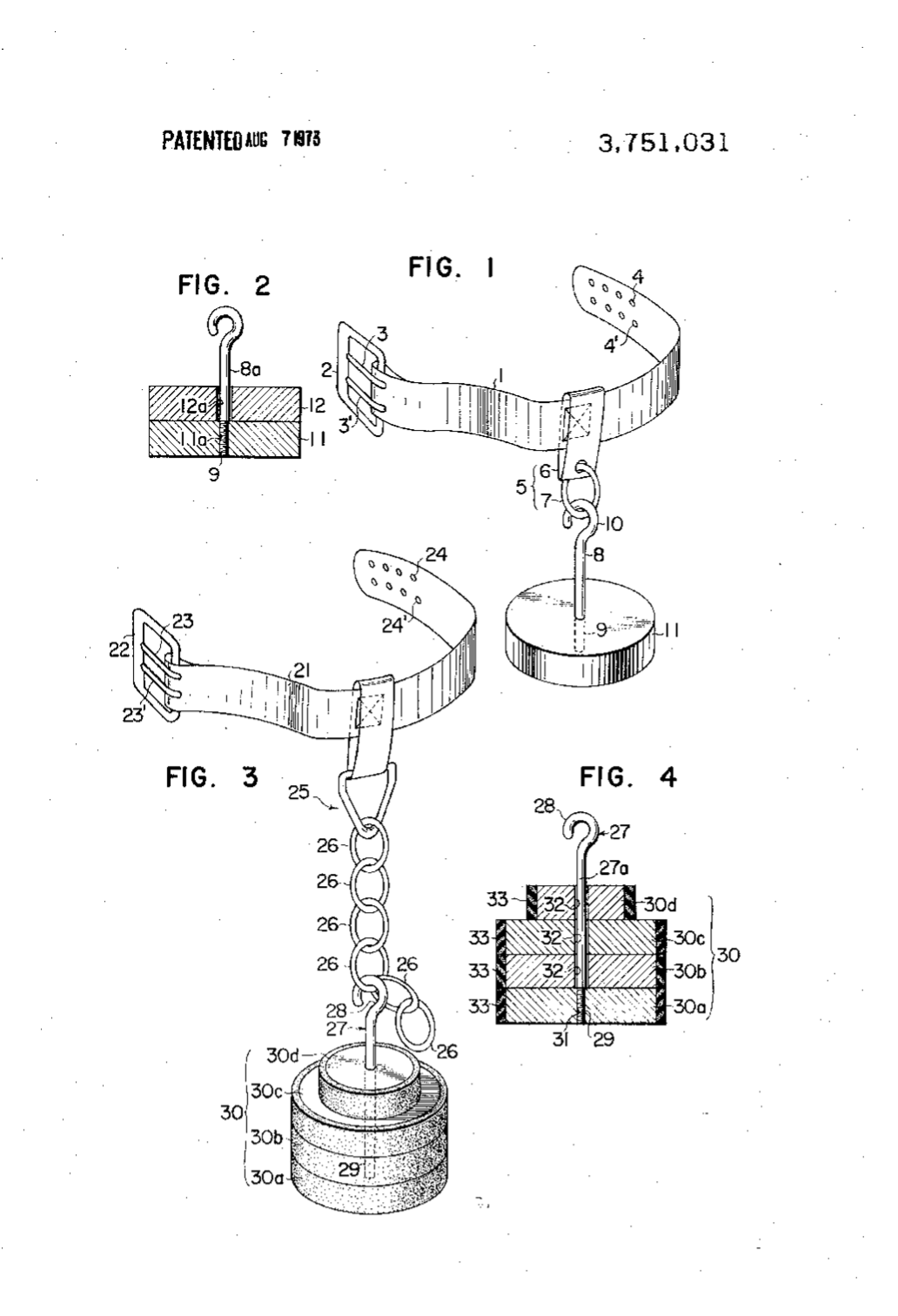
Dip belts emerged in the modern strength culture as an answer to the ceiling effect of bodyweight-only training. The late 20th century witnessed a revolutionary surge in dip belts’ adoption in bodybuilding, powerlifting, calisthenics, and subsequently, in home-training solutions. The modern dip belt is a waist-worn belt with weights suspended with a chain. It was patented in the US in early 1970s under the US Patent no. 3,751,031.

US Patent No. 3,751,031
This article highlights the modern story of dip belts; their adoption, their refinement over the decades, and their cemented role in the modern fitness culture.
The Limits Posed by Bodyweight Training
You must be familiar with the “Progressive Overload” concept. It implies that the stress placed on a muscle group must be increased gradually over time. This is a cardinal rule for continued strength and muscle development. According to the National Academy of Sports Sciences, just maintaining the load is not enough; muscle growth will not progress without continuously increasing the stimulus.
The solution was pretty straightforward in the case of machines and free weights. The bodyweight training was another story. In the case of dips and pull-ups, the functional ceiling was soon achieved. No further strength and hypertrophy were possible with mere repetition. The weighted dip belts were the answer to this problem. It’s simple mechanics transformed the bodyweight movements into progressively loadable ones.

Weighted Dip Belts and the Bodyweight Culture
From the 1970s onwards, a commercial gym culture was expanding, and strength training methodologies were also evolving, particularly in North America and the UK. The focus was now on targeting specific muscle groups. By now, the dip had already secured its place as an effective exercise targeting triceps, pectoralis, and anterior deltoids. Arnold Schwarzenegger’s “Encyclopedia of Modern Bodybuilding” (1985) includes weighted dips with plates attached to a belt as a core exercise in chest and triceps sections.
Academia.edu
With bodyweight alone, the ceiling problem remained with dips. Commercially manufactured dip belts began appearing around this time and became integral parts of product lines and broader gym equipment.
In “Keys to the Inner Universe” (1979) Bill Pearl has included the use of dip belts and chain apparatus as part of established body building practices, proving that dip belts’ use had established by then. These belts allowed trainees to add plates progressively, just like you would add to a barbell. The weighted increments were facilitated as markers of development that could be measured. For bodybuilders, strength trainers, and those interested in advanced calisthenics, dip belts signaled progression beyond beginner levels.

Pearl, B. (1979). Keys to the Inner Universe.
Powerlifting: Weighted Accessories Normalized
Though squats, bench presses, and deadlifts are the three pillars of powerlifting, they depend on the strength of assisting muscle groups. Take the case of the bench press. Without strengthened triceps, it is not possible to excel. Weighted dips directly target triceps’ buildup. Louie Simmons’ “Westside Barbell Book of Methods” published in 2007 explicitly linked triceps’ strength with bench press performance. The loaded dips helped solve the issue of lockout weakness, often faced by powerlifters. This made the dip belts indispensable for broader competition lifting frameworks.

Westside Barbell – The Book Of Methods
Modern powerlifting programming functions around precise volume and intensity management. Dip belts with their incremental loading ability fit perfectly in this equation. By the early 21st century, the dip belt had become a staple accessory tool to target muscle weakness and incremental performance enhancement for powerlifters.
Dip Belts and the Rise of Calisthenics Culture
The rise of calisthenics around the globe surged post 90s. It reflected a distinct cultural phenomenon with its street workout communities. Urban parks, public spaces, and street corners all became spaces for a highly visible training culture focusing on body weights.
Over time, calisthenic athletes encountered the same ceiling issues. Dip belts were seen as a culturally acceptable solution as they achieved the objective without interfering with the movement. Weighted dips also became a principal aspect of the Streetlifting culture that emerged later on.
YouTube videos also played a crucial role in the popularization and export of this culture. This digital visibility enhanced the symbolic appeal of dip belts as an elite performance tool. This culture was formalized with the establishment of World Street Workout and Calisthenics Federation (WSWCF) in 2011 in Riga, Latvia. This institutionalized the informal status of dip belts within the calisthenics world as an essential competitive equipment.

World Street Workout and Calisthenics Federation
Dip Belt’s Role in Physical Therapy
Dip belt’s role in modern fitness goes beyond generalities into specific healthcare environments like athletic recovery. Physical therapists are increasingly using dip belts to advance patients from recovery to strength-building stages. As early as 1948, Thomas L. DeLorme and Arthur Watkins’ “Technics of Progressive Resistance Exercise” had established the basis of incremental loading principles in rehabilitation. It serves as the gold standard for rebuilding musculoskeletal strength.
With its incremental loading mechanism, dip belt puts this principle directly into practice and facilitates upper body rehabilitation. Healthcare personnel working on athletic recovery including those with qualifications such as online family nurse practitioner degree rely on progressive resistance frameworks to design return-to-training programs. These programs are especially helpful for patients recovering from injuries to rebuild their strength. The dip belt’s adjustable practicality makes it a convenient tool in this context.
Design Refinement Over the Years
The practicality principle drives the mechanism of dip belts. It consists of a belt, worn around the waist, that holds weights suspended with a chain. The materials and ergonomics of the mechanism have developed. Reinforced nylon bodies with heavy stitching of the belt, heavy-duty chains, and padded hip sections for extra comfort, as catalogued by Rogue Fitness, are some of the latest improvements over the earlier designs.

https://www.roguefitness.com/rogue-dip-belt
Home training culture has surged considerably in the 21st century due to multiple factors. The dip belt has also evolved. It is now available in a compact form to improve accessibility beyond the gym. Particularly during and after the Covid-19 pandemic, the demand for compact accessories for progressive training in limited spaces became prominent. The dip belt’s inherent simplicity and durability, with its minimalistic properties, rightly fit into this context.
Contemporary Applications
Since its popularization in the late 20th century, the application and relevance of dip belts have evolved across diverse training environments and goals. The role of weighted dips in hypertrophy and accessory strength programs remains standard. For powerlifters, its supporting role in the bench press remains irreplaceable. The same is the case with calisthenics, where a dip belt allows athletes to move beyond bodyweight.
NCSA- Foundations of Fitness Programming (2015)
The convenience and closeness to the natural movement patterns offered by dip belts make it far superior to weighted vests or holding weights between the ankles. The fact that it allows reliable tracking of progress further adds to its appeal. However, the weight increments must be made systematically to avoid any injuries or strain. The National Strength and Conditioning Association’s “Foundations of Fitness Programming” (2015) manual specifies systematic load progression which directly validates dip belt’s incremental loading mechanism.
Conclusion
The dip belt’s rise to prominence is owed to the recurring problem presented by the bodyweight ceiling. The same tool catered to the needs of bodybuilders, powerlifters, and calisthenic athletes. The natural movement pattern that it follows, along with progressive loading, is the reason behind the dip belt’s rise in the 21st century and contemporary appeal. With its ability to solve a real problem simply, dip belts are likely to remain relevant across evolving training cultures.
Author Bio
Introducing Muhammad Tayyab, a dedicated freelance writer specializing in health and lifestyle topics. With a strong background in the healthcare industry, Muhammad’s insightful and creative approach to wellness empowers readers to lead healthier, more fulfilling lives. When he’s not crafting inspiring articles, you’ll find Muhammad exploring nature, experimenting with nutritious recipes, or immersed in a captivating book.