


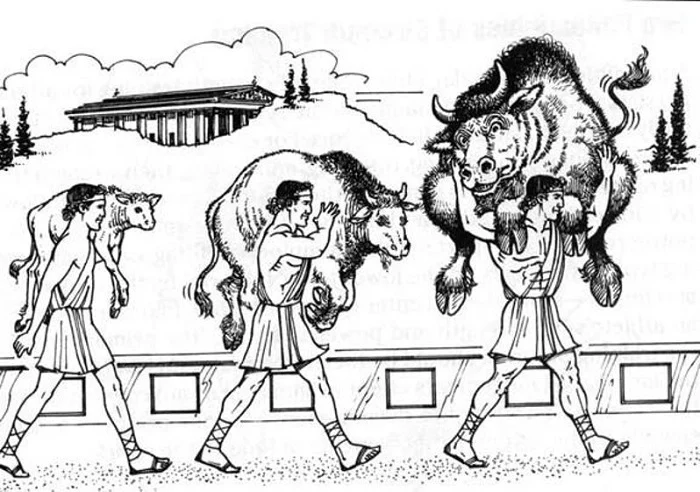

You’ve heard this story a thousand times. Ancient Greek wrestler Milo of Croton invented progressive overload by carrying a calf every day until it grew into a bull—the first gym bro to crack the code of getting stronger by gradually increasing the load.
It’s all over Instagram fitness posts, repeated by influencers and treated as gospel in every beginner’s guide to strength training. The story is neat, intuitive, and gives modern lifting culture the ancient pedigree it desperately craves.
There’s just one problem: it’s complete bullshit.
Well, not complete bullshit. Milo was real, and he was genuinely one of history’s most legendary athletes. But the progressive overload story? That tells us way more about modern fitness anxiety than ancient training methods.
Here’s what actually happened. Milo of Croton was a real historical figure, active in the late sixth century BCE and genuinely one of the most celebrated athletes of the ancient world, with multiple Olympic victories in wrestling. But when ancient writers like Pausanias and Athenaeus wrote about him, they weren’t interested in his training methods. They wanted to tell stories about spectacle and excess.
Pausanias focused on Milo’s party tricks—standing on a greased discus, holding a pomegranate without crushing it—and his eventual death when his hands got trapped in a split tree trunk. Athenaeus presented Milo as the ultimate glutton who could carry a four-year-old bull around the Olympic stadium and then eat the entire thing in one sitting. These guys were writing about a legendary figure of wonder and moral drama, not documenting workout routines.
The actual sources never mention a systematic calf-to-bull training program. That story appears in later retellings, but it’s presented as another example of Milo’s freakish strength, not as a method you could follow. Ancient athletes definitely understood training progression—archaeological evidence shows they used graduated training methods and seasonal periodization. But they kept that knowledge practical and local, embedded in coach-athlete relationships, not written down as universal principles that fitness influencers could quote for content.
The real transformation of Milo from legendary strongman to exercise science pioneer happens much later, and for reasons that have everything to do with modern insecurities.
The Renaissance revival of classical antiquity did little to shift this framing. Artists and humanists were fascinated by Milo, but primarily as an opportunity to explore the muscular male body and the moral drama of hubris. Woodcuts attributed to Titian’s workshop and later sculptures by figures such as Pierre Puget depict Milo straining against the tree that traps him, moments before his death. These images belong to a wider visual culture concerned with anatomy, proportion, and the tragic consequences of overreaching. Milo becomes a vehicle for thinking about the limits of the body, not about how to programme its development.
Here’s where it gets interesting. The fitness industry’s obsession with Milo explodes in the late 1800s and early 1900s, right when modern strength training is becoming a commercial enterprise. This isn’t coincidental—it’s driven by a very specific kind of cultural panic.
Picture this: industrialization is moving men away from physical labor and into office jobs. Middle-class guys are suddenly worried they’re going soft, losing their masculine edge to desk work and urban living. Sound familiar? It’s the same anxiety driving today’s “return to traditional masculinity” content and biohacking trends.
Classical antiquity offered the perfect solution. Ancient Greece and Rome weren’t just civilizations—they were brands representing peak physical development and authentic manhood. If you could claim your barbell system or training method was actually rediscovering ancient wisdom, you weren’t selling something new and untested. You were offering timeless truths about human strength that had somehow been forgotten.
The past became a marketing tool. Ancient bodies became advertisements for modern anxieties.
By the 1880s, you start seeing Milo pop up in exercise manuals as historical backing for whatever system the author is selling. But the smoking gun comes in 1925 with a publication by the Milo Bar-Bell Company of Philadelphia. They literally publish an essay called “The Originator of the Progressive System” that presents Milo as the inventor of progressive exercise—carrying that calf daily as it grows into a bull, unknowingly applying the principle of gradual overload.
This is the moment. Milo stops being a legendary wrestler and becomes the founding father of scientific training. The ancient story gets completely reorganized around modern fitness obsessions: consistency, incremental load increases, disciplined self-improvement.
And it’s happening in an advertisement. The Milo Bar-Bell Company isn’t just selling equipment—they’re selling a connection to an imagined Greek golden age where men were naturally strong and noble. Milo becomes a brand ambassador for barbells, posthumously endorsing a training system that wouldn’t exist for another 2,500 years.
From there, the story just snowballs. Mid-twentieth-century exercise science formalizes “progressive resistance exercise” and gives it scientific vocabulary, but the Milo narrative is already baked into popular fitness culture. Coaching manuals and educational materials routinely present him as the ancient predecessor to modern training methods. The legend gets woven into a neat story where current training science appears as the natural evolution of classical wisdom.
But here’s what’s actually striking about this whole thing: it’s not that the Milo story is wrong. Myths have always changed and been repurposed—that’s what myths do. What’s remarkable is how perfectly Milo’s legend has been reshaped to serve modern training ideology. Think about it: Ancient sources gave us spectacle, excess, and moral drama. Renaissance artists gave us anatomy and the consequences of hubris. Modern fitness culture turned Milo into a training manual. The calf became a barbell. The bull became progressive loading. Antiquity became a mirror reflecting exactly the historical legitimacy that modern gym culture wanted to claim.
The real irony? This whole retrofitting project actually obscures how ancient athletes really approached training. By turning Milo into a proto-scientist, we lose sight of how Greek and Roman athletes actually understood their bodies and development—as practical knowledge embedded in specific social and cultural contexts, not as universal systems waiting for scientific validation.
Every time someone on Instagram uses Milo to explain progressive overload, they’re not sharing ancient wisdom. They’re participating in a story that says more about our need to feel connected to something timeless and proven than it does about how people actually got strong 2,500 years ago.
Milo didn’t invent progressive overload. We invented Milo as its inventor. And honestly? That’s probably the more interesting story.