


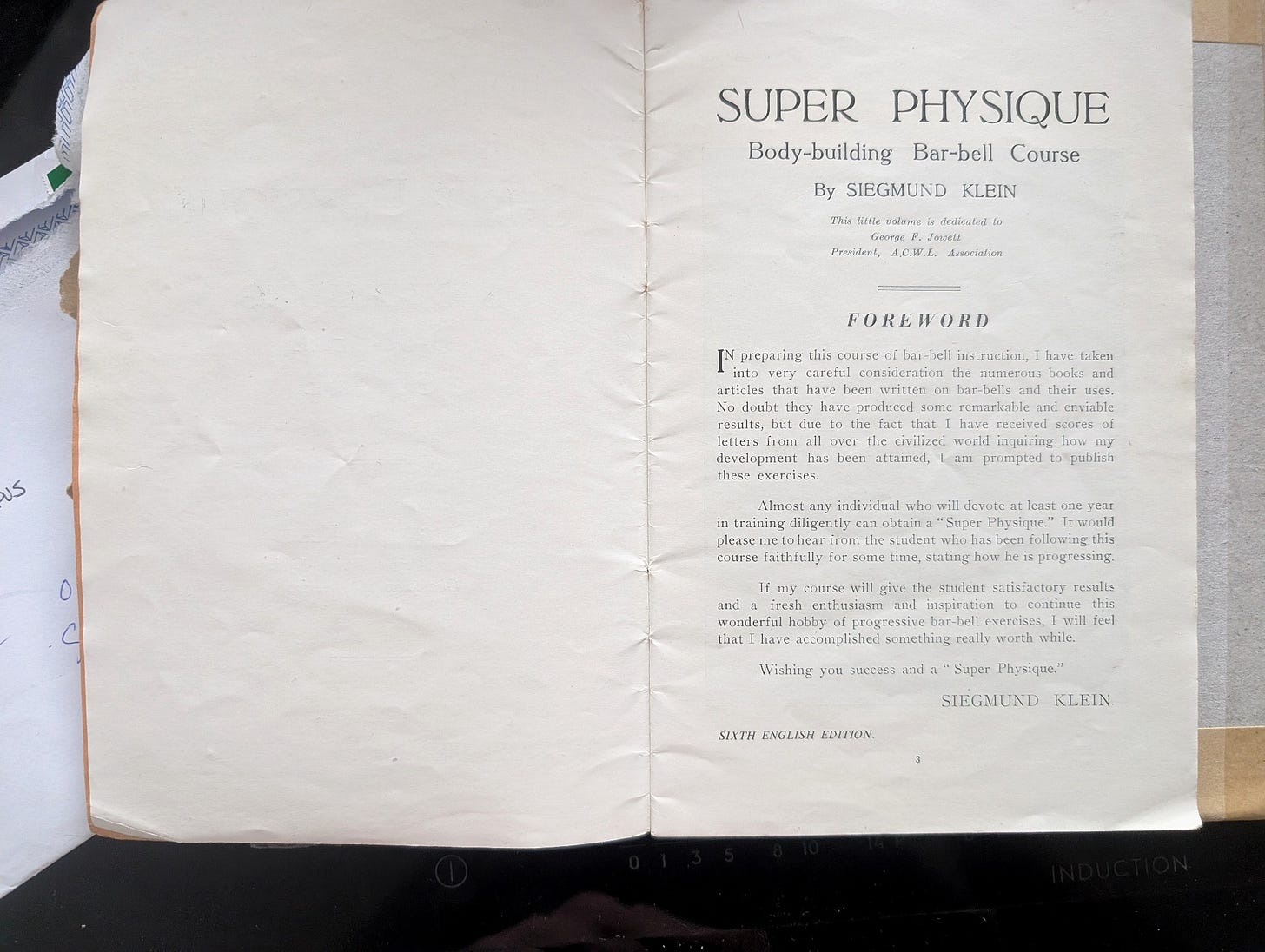


Every so often you find a fitness booklet that makes the modern gym look like it has lost its nerve.
This one is Sig Klein’s Super Physique: Body-Building Bar-bell Course, sixth English edition (c.1943), a small paper artefact from the old physical culture world where men in trunks demonstrated exercises with the confidence of minor prophets. The booklet is creased, foxed, and a little battered, which is exactly how these things should look. A pristine old exercise course always feels suspicious, like a vintage car that has never smelled petrol.
Klein’s booklet promises the reader a “Super Physique,” which is a phrase so gloriously unembarrassed it almost deserves public funding. Modern fitness writing tends to tiptoe around its desires. We talk about wellbeing, longevity, resilience, health markers, better movement, improved quality of life, and all the other respectable language we use when we are trying very hard to pretend we do not also want arms that look good in a T-shirt. Klein’s world had no such problem. You lifted weights because you wanted strength, muscle, control, and a body that announced a certain amount of personal effort before you had even opened your mouth.
The lovely thing is that beneath the posing and the promise, the booklet is far more sensible than it first appears. Klein was part of a physical culture tradition that blended strength training, bodybuilding, acrobatics, health reform, stage performance, mail-order instruction, and entrepreneurial self-fashioning. The barbell had not yet been tidied into the categories we now take for granted. It was a training tool, a theatrical object, a measuring device, a badge of seriousness, and occasionally a prop for doing something that made your relatives worry.
That is why this old course still has value. I am not suggesting anyone should recreate the whole thing literally, especially the more alarming movements where the barbell seems to be placed wherever gravity might make the outcome funniest. What is worth recovering is the attitude. Klein’s training world treated strength as a skill. A strong person should press, squat, curl, balance, bridge, swing, brace, and control awkward objects without turning purple or needing a motivational playlist called ‘Beast Mode.’

Klein’s introduction, written in the booming register of old physical culture publicity, places him among the great American strength men of his day. He is described as an author, instructor, performer, and model of muscular development. His statuesque poses had circulated widely, and the notes on his career present him as a man who moved from youthful weakness to public strength through disciplined exercise. This was a familiar origin story in physical culture…the weak child becomes the exceptional man. The body becomes proof that one has mastered the self, or at least become very good at standing under strong lighting.
There is exaggeration in this world, obviously. Physical culture entrepreneurs were never shy. They sold courses, charts, expanders, barbells, magazines, foods, tonics, and dreams of bodily transformation to readers who often trained at home with limited equipment. Yet it would be lazy to dismiss the whole thing as hokey or kitsch. These booklets are historical evidence of how ordinary people were taught to think about the body as a project. They show us how strength became portable, domestic, aspirational, and strangely intimate. You could buy the course, clear a bit of floor, and imagine yourself entering a fellowship of iron-minded men from London to New York.
The modern reader should steal from Klein and history in general without becoming trapped by him. That means keeping the useful parts and leaving the circus acts alone unless you already know what you are doing. The aim is a session inspired by the booklet rather than a museum re-enactment carried out in your garage while your partner quietly Googles ‘can dumbbells void house insurance?’
The Klein-ish principles

The best surprise in the booklet is the advice near the back. Klein recommends sensible practice, warns against excessive exercise, suggests working in moderate repetitions, and encourages the reader to train regularly without being foolish. His general advice is closer to ‘be consistent and do not be an idiot’ than the photographs might suggest.
That matters, because historical fitness often gets flattened into novelty, especially as TikTokers discover it for content (god I’m old and cranky). We see an old exercise, laugh at the shorts, and assume the people involved were either geniuses or lunatics. Usually they were something more interesting….they were experimenting or building systems before training systems had settled. They were trying to persuade readers that the body could be remade with effort, apparatus, and discipline. Some of their claims were wild, while much of their practical advice was boring in the best possible way.
A Klein-inspired workout should therefore feel like practice. The weight should be light enough to control and reps should look crisp. The session should leave you feeling trained rather than exhausted (Hello Lee Haney’s ‘train don’t strain’). The whole thing works best if you approach it as a historical experiment with useful side effects for your shoulders, trunk, hips, grip, and general sense of mischief.
The equipment
You need a barbell if you have one, dumbbells if you do not, and a kettlebell if that is what is lying around. A light adjustable dumbbell is probably the closest modern equivalent to the sort of home-training apparatus many readers would have used. A mat helps. A bench is useful. A mirror is optional, although Klein would probably approve of checking whether you look good.
Use weights you can use with ease. This is important. The old photographs look dramatic because the poses are clear, the body is controlled, and the implement is being displayed as much as lifted. If every rep looks like a small fight between you and the dumbbell, reduce the load.
The workout
One-arm clean and press
3 sets of 5 each side
Begin with the movement that best captures the old physical culture mood. Take a dumbbell or kettlebell from the floor to the shoulder, pause, brace, and press it overhead with as little bodily negotiation as possible. Lower it under control and repeat.
This is a better exercise than it has any right to be. It asks the grip to work, the trunk to behave, the shoulder to stabilise, and the legs to contribute without turning the lift into interpretive dance. The one-arm press also teaches the lifter something the modern bilateral gym programme can sometimes hide, namely that one side of the body may be stronger than the other.
Keep the reps clean and pause at the shoulder. Finish each press properly. If you find yourself leaning back like a man trying to avoid bad news or an unwanted kiss, the weight is too heavy.
Two-arm pullover
3 sets of 10 to 15
The pullover was beloved in older physical culture systems. It promised chest expansion, shoulder development, improved posture, and a feeling that the ribcage had been opened like a stubborn window. Some of the old claims around chest expansion were overcooked, but the movement remains excellent when done sensibly.
Lie on a bench or the floor with a light dumbbell, plate, or barbell. Take the weight behind the head under control, feel the stretch through the upper body, and bring it back smoothly.
This is one of those exercises that feels old in a good way and reminds you that upper-body training once had more in common with posture, display, and bodily carriage than with simply accumulating pressing variations until your elbows make a noise like an old gate.

Deep knee bend
3 sets of 8 to 15
Klein’s course includes deep knee bending and, in the wider strongman tradition, related barbell movements that now make safety-conscious coaches reach for a chair. The Steinborn-style squat, where a barbell is tipped onto the back from the floor, has historical glamour, but historical glamour is often just danger photographed nicely.
For our purposes, do a goblet squat, front squat, high-bar squat, or bodyweight squat. Descend as deeply as you can while keeping control. Stand up cleanly. Treat the movement as training for the thighs, hips, lungs, and dignity.
The deep knee bend had a special place in older training because it was hard, simple, and impossible to fake. It made the body work as a unit. It also gave physical culturists a way to talk about vitality, circulation, development, and willpower in one sweaty paragraph. You do not need to accept every old claim to appreciate the exercise. Squatting remains a superb way to find out whether your body is currently a team or a committee.
Two-arm press
3 sets of 6 to 10
Use a barbell or dumbbells. Stand tall, brace, and press overhead with control. The old press was a prestige lift, and for good reason. It made strength visible. A clean overhead position still carries a certain authority, even if you are doing it beside a laundry basket.
Do not chase a max here as the aim is to make each rep look deliberate. Klein’s world cared about display, and display is useful because it punishes sloppiness. Imagine a grainy black-and-white photograph being taken at the top of every rep. You are allowed to look tired but you are not allowed to look like the weight has just explained tax law to you.
Abdominal raise
3 sets of 8 to 15
The booklet includes abdominal raising movements, and they fit perfectly with the physical culture concern for bodily control. Do lying leg raises, reverse crunches, or hanging knee raises. Raise the legs smoothly, lower them slowly, and stop before your lower back begins writing its own memoir.
Older physical culture did not treat the midsection as a beach-season accessory. The trunk was the centre of the system. It allowed the lifter to press, bridge, balance, bend, twist, and handle weight in awkward positions. Abs were useful because the body was expected to do things. That is a healthier idea than much of what came later, even if it was often accompanied by photographs of men staring into the distance like they had just invented discipline.

Two-arm swing
3 sets of 10
Use a kettlebell if you have one. A dumbbell can work, provided you are sensible. Hinge at the hips, let the weight travel, and snap the movement with the legs and hips rather than raising it with the arms.
The swing gives the session rhythm. A lot of modern lifting is controlled, braced, and linear, which is useful, but the older physical culture world kept more room for dynamic movement. Swings, bends, lifts, and balances made strength feel athletic. They also carried a faint whiff of the music hall, which I consider a bonus.
Do the swings cleanly. Stop well before fatigue turns them into a lower-back séance.

The optional display round
At the end, pick a light dumbbell and do two relaxed rounds of one-arm curls, one-arm presses, lateral raises, overhead carries, and goblet squats. Keep everything easy. This should feel like practice rather than punishment.
The display round is my favourite part because it gets closest to the spirit of the booklet. Modern training often hides effort inside programming language. Physical culture made effort visible. The body was trained, then shown. That can sound vain, and sometimes it was, but there is also something appealing about taking pride in competence. You have a body. You may as well learn how to use it without apologising every five minutes. They did this because they came from music halls and vaudeville stages, places were exhibition and displays were part of your value as a physical culturist.
What Klein still teaches
The real value of this sort of workout is historical as much as physical. Klein reminds us that fitness was once more adventurous at the level of everyday practice. The older physical culturists were trying to build bodies that looked strong and could do interesting things. Their world had plenty of nonsense, but it also had a broader imagination of strength than many modern programmes allow.
Strength meant control. It meant balance. It meant being able to put weight overhead, move it around the body, squat with it, press it, swing it, and make the whole performance look intentional. There is something worth keeping there.
The booklet’s slogans are earnest in the way only old fitness writing can be. “Health is wealth” appears with a straight face. Another line insists that “strength is first, last, and at all times the ability to do things,” which is honestly better than half the manifestos currently circulating on Instagram under photographs of men looking angry near tripods.
That line is the reason to try the workout. Strength should increase your ability to do things. It should make the body feel more available to you. It should give you more options, more confidence, and occasionally a better party trick, though I accept this depends heavily on the party.
Sig Klein will not save modern fitness, and nobody needs to train exactly like a physical culturist from an old booklet. Still, there is something restorative about stepping into that world for a session. Pick up a manageable weight. Move it carefully. Make the reps look good. Take pride in the skill of the thing. Smile at the absurdity of it all.
Then, when you are finished, put the dumbbell down gently and resist the urge to launch your own mail-order course.