


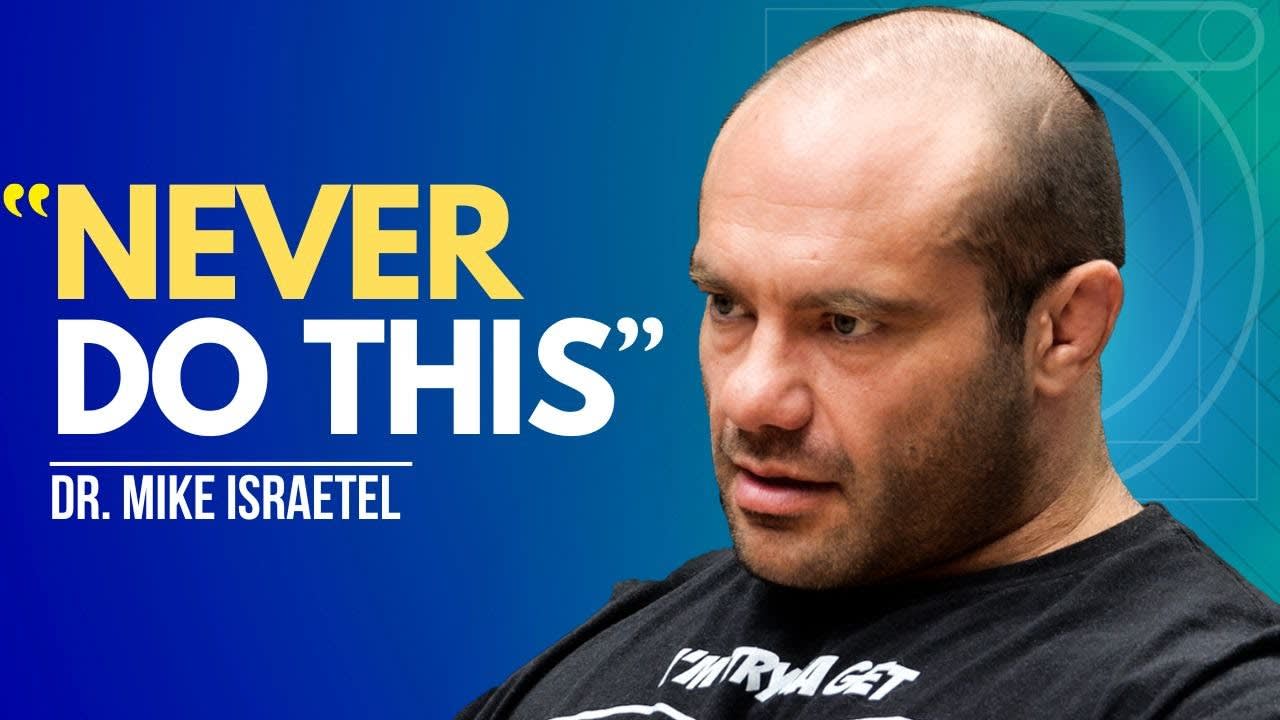


Mike Israetel has earned real authority in fitness. Through Renaissance Periodization, he has become one of the most recognizable figures in evidence-based hypertrophy training. His lectures on training volume, recovery, and nutrition are staples in gyms and classrooms. When he speaks about training, he cites peer-reviewed studies, parses physiology clearly, and backs it up with competitive experience. In that domain, he is a genuine expert.
But authority in one field does not transfer automatically to another. On his philosophy channel, he speaks with the same confidence about race, politics, and technology. The problem is not that he speaks… everyone has the right to opinions. The problem is that he presents contested or discredited claims as straightforward science. This is expert creep the transfer of credibility from one domain into another without doing the work those new fields demand.
And when the subject is race, politics, or technology, expert creep is not harmless. It can mislead.
The Long History of Expert Creep


Fitness has always produced more than training advice. From its very beginnings, figures who built credibility in the gym have drifted into domains far beyond their formal expertise. Eugen Sandow, often hailed as the forefather of modern fitness, embodied this tendency. He was not content to demonstrate poses or prescribe dumbbell routines. Sandow issued advice on military preparedness, offered medical opinions, and presented himself as a guide to national vitality. His authority in building muscle was transposed into authority on how to build nations and bodies alike. Audiences who trusted Sandow’s physique also trusted his prescriptions for war readiness or public health, even when his claims were speculative or politically loaded.
That logic has not disappeared. Today’s fitness influencers inherit Sandow’s mantle, packaging hypertrophy tips alongside commentary on politics, psychology, and technology. Their audiences do not follow disciplines; they follow personalities. Which is why when Mike Israetel, a genuine authority in evidence-based strength training, extends his confidence into race science, political philosophy, or artificial intelligence, the echoes of Sandow are unmistakable. The difference is scale. Sandow addressed readers of Physical Culture and theatre crowds. Israetel speaks to hundreds of thousands across YouTube and Instagram.
Race and Intelligence
In a clip titled Is Intelligence Really Different Among the Races?, Israetel introduces the topic by noting that “people get very sensitive” about the issue. At around the two-minute mark, he states
Race is biological … it pervades almost everything … and it results in differences in ability.
Immediately afterwards, he added “That doesn’t mean one group is better or worse than another.” And while that qualification matters, but it doesn’t change the central claim. The message is that race is a biological category that carries ability differences, especially in intelligence.
The difficulty is that mainstream science disagrees. Population genetics shows that while human variation is real, it does not map neatly onto racial categories. The American Anthropological Association has stated unequivocally that race is a social construct, not a biological essence. Studies across the twentieth century found more variation within groups than between them. Intelligence differences across populations are best explained by environment, education, nutrition, and inequality, not genes.
This is not a case of a brave truth-teller saying what others won’t. It is a case of repeating arguments that science left behind because the evidence did not hold. Claims linking race and intelligence were central to craniometry, phrenology, and early IQ testing. They were used to justify segregation, immigration quotas, and eugenics. As methods improved, these claims collapsed. That is why the consensus moved.
When Israetel presents “race is biological” as obvious, he isn’t ahead of the curve. He is behind it.
The audience reception shows why this matters. Beneath the video, some commenters applauded him for “thank you for speaking the truth” and “100% agree with you sir, and I catch your drift.” His drift? In the same video Israetel says that in the current political climate he would not share any more about his beliefs lest he is cancelled.
For balance, there are direct pushbacks too. The same comment section is full of criticism. There were also counter-videos dissecting why his claims don’t hold scientifically. The very fact that such rebuttals exist shows that his words have influence well beyond a passing comment.
Political Philosophy
Israetel applies the same confidence to politics. In My Political Philosophy, he begins that “the three principles that matter are freedom, wealth creation, and cleanliness.” Later he elaborates, “if a politician gives you these, they’re good. If they don’t, they’re bad.”
It sounds straightforward. But the framework fails under its own weight. Freedom itself is contested. Negative freedom (freedom from interference) and positive freedom (freedom to achieve potential) often conflict. Wealth creation is important, but without considering distribution it risks justifying growth alongside deep inequality. Cleanliness is the vaguest of all. If it means public order, then authoritarian states that suppress dissent but keep streets orderly (like in Singapore) score well. If it means literal hygiene, it barely functions as a political principle at all.
The point is not that his rubric is reductive, all frameworks are. It is that his framework collapses when applied consistently. By his own test, regimes with wealth and order but no freedom come out “good,” while messy democracies come out “bad.” That is not careful reasoning. It is a slogan.
Technology and AI
Israetel’s optimism about technology shows the same pattern. In We ALREADY Know How to Build ASI, he says that “The path to artificial superintelligence is already mapped. We know how to do it, it’s just a matter of engineering.” A few minutes later, he insists “It’s inevitable — it’s just a question of when.”
This is not a neutral claim. It collapses a contested debate into a certainty. Even among AI experts, there is wide disagreement. Some, like Nick Bostrom, argue that superintelligence is plausible but fraught with existential risk. Others, like Gary Marcus, doubt it is achievable at all in the foreseeable future. Still others, like Stuart Russell, emphasize governance, ethics, and safety as crucial uncertainties. There is no consensus on inevitability, timeline, or outcome.
Israetel presents contested ground as settled fact. The logic echoes his gym advice … add weight, adapt, progress. But societies are not muscles, and history is not a hypertrophy curve. Development depends on politics, economics, and ethics as much as engineering. Presenting superintelligence as guaranteed reassures his audience without preparing them for the complexity experts actually debate.
In the comments, viewers echoed his certainty. Some repeated his inevitability framing in other discussions. This is how confidence without evidence multiplies.
What Expertise Does and Doesn’t Transfer
It’s worth being fair. Israetel is not without relevant training. He holds a PhD in sport physiology. He is a scientist by background, and that training gives him strong grounding in biology, statistics, and critical thinking. That competence does carry some weight when reasoning about broader questions.
But genetics, anthropology, political theory, and technology studies are specialist fields. They each require immersion in decades of literature and engagement with existing consensus. They are not solvable by intuition alone. Expertise is not infinitely portable.
As someone who studies the history of sport and physical culture, I know this tension personally. My research often requires moving across disciplines into histories of medicine, sociology, and anthropology. The lesson is always the same, when you step outside your home field, you move with humility, careful reading, and respect for existing knowledge. That is what is missing in Israetel’s philosophy channel.
Why It Matters
Some might argue, what harm in a coach dabbling in philosophy? The harm lies in scale and framing. Israetel has hundreds of thousands of followers. Many already trust him as a scientific authority. When he says “race is biological and tied to ability,” they hear science. When he says “superintelligence is inevitable,” they hear certainty.
This isn’t about forbidding him to speak. It’s about accuracy. On race, he is repeating ideas science discarded decades ago. On politics, he is applying a framework that collapses under its own terms. On AI, he is presenting contested debate as settled fact. The issue is not that he has opinions. It is that he presents them as truths.
Beyond Israetel: The New Economy of Expertise
What Israetel illustrates is not just individual overreach. It is a symptom of a larger cultural shift. We live in what might be called the new economy of expertise, where authority is portable and transferable across platforms. Audiences do not follow disciplines, they follow personalities. If someone earns their trust in one domain, that trust is easily repurposed in another.
This is not unique to fitness. Andrew Huberman, a neuroscientist, now delivers relationship advice and diet prescriptions far beyond his research base. Jordan Peterson, trained as a psychologist, became a global commentator on politics, religion, and culture. Andrew Tate parlayed a kickboxing career into a philosophy of masculinity and politics. Joe Rogan built authority through MMA commentary and then leveraged it into conversations on science, medicine, and everything else. The pattern repeats, an earned credential in one arena becomes a passport into many.
The logic is powerful. Influencer culture thrives on seamless authority. Followers want guidance not just on training or diet, but on morality, politics, and the future. When a trusted figure speaks, their credibility flows across categories. That is how expertise becomes currency, it becomes something traded and redeployed, often without boundaries.
The risk is clear. Expertise is not infinitely transferable. A PhD in physiology equips you to speak with authority about muscles, but not about race science. Clinical practice in psychology prepares you for therapy, not geopolitics. An MMA record teaches discipline, but not macroeconomics. When credibility migrates without rigor, misinformation gains a privileged voice.
How do we guard against this? A simple framework helps. When someone pivots into a new domain, ask three questions:
- What is their training here? A degree or publication record is not everything, but it matters.
-
What is the consensus? Do they acknowledge and engage with existing knowledge, or present contested claims as settled?
-
How do they handle disagreement? Do they welcome counterarguments and sources, or do they brush them off as “political correctness” or “fear”?
These questions don’t silence anyone. They equip audiences to distinguish between genuine insight and expert creep.
Israetel is valuable precisely because he shows the pattern clearly. In fitness, his rigor is genuine. In race, politics, and technology, his confidence outpaces the evidence. The issue is not that he strays outside his lane, but that he carries the authority of the gym into domains where it does not belong. To be clear, this is not a critique of Israetel’s intentions or character. He has spoken powerfully about his own struggles with mental health and body image, and he comes across as a thoughtful individual. The issue is scope, the limits of expertise, and the responsibility that comes with presenting contested claims as settled fact.
And that, in miniature, is the story of our age. Expertise has become portable, followings are platform-agnostic, and the boundaries between disciplines blur under the glow of influencer culture. Recognising this pattern is the first step toward resisting its distortions. Israetel is not an outlier. He is the rule.