
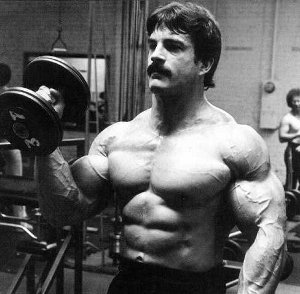
Given the current vogue for Mike Mentzer and high-intensity training, I thought it would be cool to look at John Little‘s 2008 interview with Iron Man magazine. Little is a Mentzer expert, and has written several books on his training methods. Here we get a unique insight into Mentzer as a person, and as a competitor.
Q: Mike Mentzer believed in using one set to failure. I can see how that might work for smaller muscle groups like biceps, but how can you stimulate maximum growth in bigger muscle groups like the chest with only one set?
A: The size of the muscle group you’re training doesn’t change the fact that muscle fibers are recruited and stim- ulated sequentially—from slow twitch to fast twitch—by one set taken to a point of momentary muscular failure. The scientific literature supports the concept of one set taken to failure as at least the equal of multiset work, which indicates that doing any more sets would be a waste of time and recovery resources. That will delay the growth your workout may have stimulated.
Mike looked carefully at that dynamic:
“If you were to launch an investigation aimed at discovering how many sets were required to achieve optimal results, where would you start? If you started at 20 sets and that didn’t work, where would you go? Down to 19 sets or up to 21? The logical place to launch your investigation is with the least number possible, namely one set. You can’t do any fewer sets. If one doesn’t work, then you try two. I can tell you unequivocally, though, that one set per exercise is all you need to achieve optimal results.”
Most bodybuilders regard working out as an endurance contest, which it is not. Mike often said that the idea is not to go into the gym to see how many sets you can do or how long you can mindlessly endure. Your purpose is to go in as an informed, intelligent, rational human being and perform only the amount of exercise required to stimulate muscular growth. Note the distinction. As it turns out, the precise amount of exercise required to stimulate growth isn’t nearly as much as people have been led to believe or would like to believe. According to Mike:
“One of the central issues in my book Heavy Duty II: Mind and Body is that the mistake over all these decades has been that more is better and less is better. Those ideas are both wrong, and they both lead to training problems and a lack of satisfactory progress.
“The idea is not more is better or less is better but that precise is best. Precision is the key. Exactly how many sets per workout and how often? It’s similar to what happens when you take a medication. Once you discover what medication is required, the next logical step is to discover how much—the dosage. How much of the drug should you take and how often? In fact, I make the point again in Heavy Duty II that exercise science should flow from the principles of medical science.
“In bodybuilding as in medicine we’re looking to effect the desired physical result, in our case not by taking a drug but by imposing the appropriate training stimulus: high intensity. Once we know that, we can determine volume and frequency.”
The majority of volume bodybuilders perform an arbitrary number of sets, with the exercise science establishment advocating up to 60 sets a day, six or seven days a week. That’s gross overtraining, and for the bodybuilder who’s not genetically gifted or taking steroids, it’s useless.
What Was Mike Mentzer Like?
Q: You knew Mike Mentzer personally for some 20 years. That must have been amazing. I discovered Mike’s writings six months ago when I purchased The Wisdom of Mike Mentzer and have since purchased High Intensity Training the Mike Mentzer Way, Heavy Duty II: Mind and Body and anything else I can get my hands on. He was such an intelligent man, and I love the philosophy component he brought to body-building. Since you knew him personally, what was he like— was he serious all the time?
A: Mike Mentzer was the most fascinating and stimulating friend I’ve ever had and probably ever will. There was always something “new” going on—a new idea, a new application, new knowledge. I vividly recall speaking with him just prior to my leaving for Helsinki, Finland, to cover the ’92 Mr. Olympia contest and asking him a question about the value of partial repetitions for a book I was doing. He gave me one of the most fascinating insights
into the issue of recovery ability as it relates to training volume and frequency. It broke new ground in bodybuilding, and I was so elated that I played the recording of the interview no less than 10 times. It was several months before the release of his revised Heavy Duty, so it was exciting.
As for Mike’s being serious all the time—hardly! He was one of the funniest people I’d met, something I’ve noticed about most people who are very intelligent. Will Durant once remarked that humor is aligned with knowledge, as both are born from a wide or deep view of life. Mike was someone with whom I could speak about any topic—from bodybuilding training to music to art to philosophy to politics to writing to business to fashion. A bit of trivia here—Mike was one of the few bodybuilders ever to be profiled by GQ magazine. In one of our last conversations, I told him that Friedrich Nietzsche, whom Mike had read extensively in the 1970s, had written music for piano that had recently been produced. He was so excited about that and couldn’t wait for me to send him the CDs so he could gauge Nietzsche’s “sense of life.”
Once at a small coffee shop in Venice, California, we got into a discussion of how tradition-bound so many people in bodybuilding are. Mike opined that there was a strong mystical element that had been passed down in bodybuilding, where bodybuilders were supposed to go with their “feelings” or “instincts.” The then editor-in-chief of Muscle & Fitness had written an editorial about how it was best to “go with your gut” when training. “How does he know how to interpret a feeling in his gut?” I said. “For all he knows he might be experiencing gas—not a valid training insight.” Mike did a spit-take with his coffee and laughed so loud and so hard that I didn’t think he would catch his breath!
Mike was, above all, a benevolent soul. He was always kind and never mean-spirited, giving freely of his time to anyone who wanted to speak with him. Unlike many people in this industry, Mike left you with something more than you had before the conversation—I could go on and on. Mike Mentzer was a confidante, an ally, an adviser, a teacher, someone who made me laugh and inspired me to want to learn more about life. I miss his company very much.
Why Keep a Progress Chart?
Q: I’ve read that Mike Mentzer was a big advocate of keeping a log book or progress chart. It seems a huge inconvenience to have to carry one of those things around the gym every time I work out. I see lots of big bodybuilders at the gym I train at who don’t keep track of any of their weights, sets or reps, and they seem to be making out okay. Is a progress chart really that necessary?
A: Mike made the point that becoming a massively developed bodybuilder takes a number of years in most cases. He also believed that the time would be reduced dramatically if trainees kept a journal from day one of training. Here’s why:
“In very few arenas of human endeavor will you find anyone who takes the most direct route from objective A to objective B at the outset. Learning and moving ahead are accomplished by trial and error. Usually, we begin by making a trial, miss the mark, note the error and make the proper adjustments and then proceed to our target or goal. I’ve come to view my own training as something of a journey, whose destination is the fulfillment of my physical potential. As it is with any long journey along an uncharted path, I am bound to take the inevitable detour. It is vital that if I am ever going to reach my destination, I must avoid hitting the same blind alley, the same detours twice; otherwise I will end up like a rat caught forever in a maze, frantically seeking the one proper path that will lead me to success. Keeping a training journal is like making a map of your journey. You must make a record of every proper turn as well as every wrong one. The road to building a great physique is just too long to remember all the mistakes.”
Mike began keeping a training log in 1978 just as he was beginning preparation for the USA vs. World challenge match in Los Angeles. That discipline continued through another six competitions and ex- tended to his workouts and diets in the off-season. According to Mike:
“My journal has evolved somewhat since those first recorded observations back in June ’78. At first my journal served merely as a record of my diet and my workouts while preparing for a contest. With each succeeding contest, however, I grew increasingly aware of how my journal would serve me in the future for bigger contests. As time went on, I began keeping a record of my bodyweight before each workout, my other physical activities, as well as detailed analyses after each contest. Recently I’ve begun to keep charts that compare my fluctuating bodyweight with calorie intake and activity level so that when preparing for a contest in the future, I will know exactly what I have to eat and how active I must be each day to reach a certain condition or peak in an allotted period of time. In addition, I’ve begun recording mental and emotional patterns that attend contest training. While I haven’t had the time to analyze this particular aspect fully, I have identified patterns that lead to motivation, emotional ups and downs, as well as progress. I now am beginning to understand much better my limits as well as my strengths. For instance, in the beginning of 1979 I turned professional and was anxious to enter every show possible, as I had looked forward to the prospect of turning pro for some time.
“Recorded during the preparation of my first pro show, the Southern Pro Cup, were words and phrases that revealed an almost unbridled enthusiasm and desire ‘to prevail.’
I did prevail and won that first pro contest. As the year proceeded, however, my contest preparation was disrupted by a lot of traveling for seminars and exhibitions as well as new responsibilities, like writing a book for a major New York publisher. Each new responsibility merely added to the stress I was under, and my progress began to suffer. The continuing presence of these and other diversions caused me to place second in my second pro show, the Night of Champions, in Pittsburgh on April 19, 1978. I found stress to be additive, and the stress of training and dieting for four continuous months along with other life stresses we invariably encounter caused me to approach my preparations for the New York pro show in May ’78 with little en- thusiasm. Even more notable from reviewing my journal was that while my preparation for the show was essentially the same as for the first two, my body was not responding the way it did for the first two. I placed a dismal third in that contest.”
Losing didn’t dampen Mike’s enthusiasm. In fact, he recorded his analysis of the competition in his journal:
“I shouldn’t have entered this contest. I could see as long as two weeks preceding the show that my body wasn’t responding to the training and diet as it had previously. The physical and mental stress associated with preparing for three shows in as many months, along with certain emotional stresses resulting from family crisis ended up to be too much. I guess it just proves once again [stress researcher Hans] Selye’s notions about stress, especially that we have a limited capacity to resist and adapt before we reach exhaustion and must devi- ate, or rest.”
As far as muscle growth is concerned, rest and recuperation are as important as training and nutrition.
As you can see, in addition to simply recording training poundages and diet information, a workout chart or training journal can reveal patterns of progress, such as the effects of various training techniques on strength increases. Without it, you’re a rudderless ship, blown about by any chance wind and doomed to make the same mistake many times over.
Editor’s note: For a complete presentation of Mike Mentzer’s Heavy Duty training system, consult his books Heavy Duty II, High Intensity Training the Mike Mentzer Way and the newest book, The Wisdom of Mike Mentzer, all of which are available from Mentzer’s official Web site, http://www.MikeMentzer .com.
John Little is available for phone consultation on Mike Mentzer’s Heavy Duty training system. For rates and information, contact Joanne Sharkey at (310) 316-4519 or at http://www.MikeMentzer.com, or see the ad on the opposite page.
Article copyright © 2008, John Little. All rights reserved. Mike Mentzer quotations are provided courtesy of Joanne Sharkey and are used with permission
Discover more from Physical Culture Study
Subscribe to get the latest posts sent to your email.

I remember when we received the German version of Heavy Duty in 1981. 15 years old boys at the beginning.
Tried it for a week.
For me too hard for my training partner not hard enough…
I later used the concept for my powerlifting. A hybrid form of it.
I liked the way to train hard, infrequent in a brief fashion.
Met Mike Mentzer at Gold‘s in 1991. i think he just returned to the scene after his absence due to mental issues.
Thomas
That’s awesome Thomas and what a cool story. How was Mike when you met him? Was he still training folks then?
Funnily I’ve found similar in my training as I’ve gotten older. It was only training with an HIT coach that I realised what ‘hard’ and ‘failure’ actually meant in training. It was humbling! Now I go with a hybrid approach
Conor,
I think he had started to train people then. That was after a longer layoff in the mid to late 1980s
What is a surprise to many is the fact that Mike Mentzer had great successes after the 1980 controversy.
He did will in the US Superstar TV series ( as did Lou Fertigno)
He also continued his large ad in M&F afterwards.
Even Joe Weider criticized the outcome of the Australian results in Muscle&Fitness.
We can only speculate what would have happened in 1981-1983 had he kept competing.
Good tips! They will spend a few minutes every day